
Post-launch support: your system stays watched after handover, with no new dependency.
For companies coming out of an engagement with us who want a quiet first year on top of a complete handover. A light monthly arrangement keeps watch on what we delivered. Optional, and you can cancel with one month of notice.
- Closed scope
- One month of notice
- Documentation already on your side
What is post-launch software support?
Software maintenance and support reduced to the scope we delivered: monitoring, a fix when something breaks, security updates, and a short quarterly review. Not a ticket factory, and not a managed service you never use.
Every engagement already ends properly: documentation, one person on your side trained to run the system, credentials in your name. This arrangement adds a watch on top of that, for leaders who would rather not lose sleep over the first year. It retires a worry, not a capability: if you stop it, your team keeps everything it had the day before.
You are not buying insurance against our own bugs.
You are extending a watch over a system that is already sound. Measured in July 2026, across every engagement delivered since 2019.
- client has had to call us back on an emergency after handover
- 0
- Measured in July 2026, engagements since 2019
- follow-on contracts signed, all to extend a warranty, none to repair
- 3
- Same measurement
Backups, certificates, scheduled jobs: what you no longer have to check.
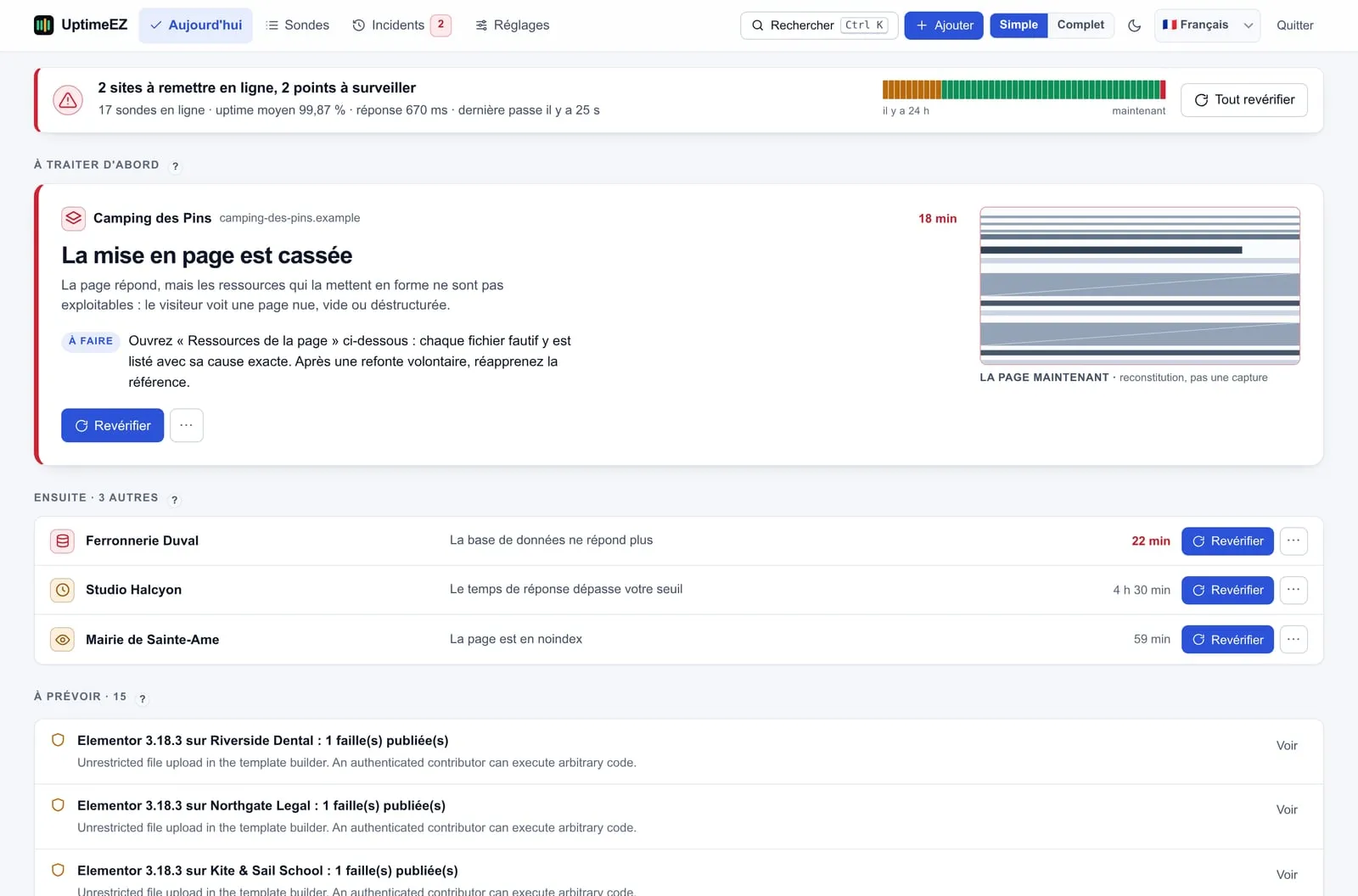
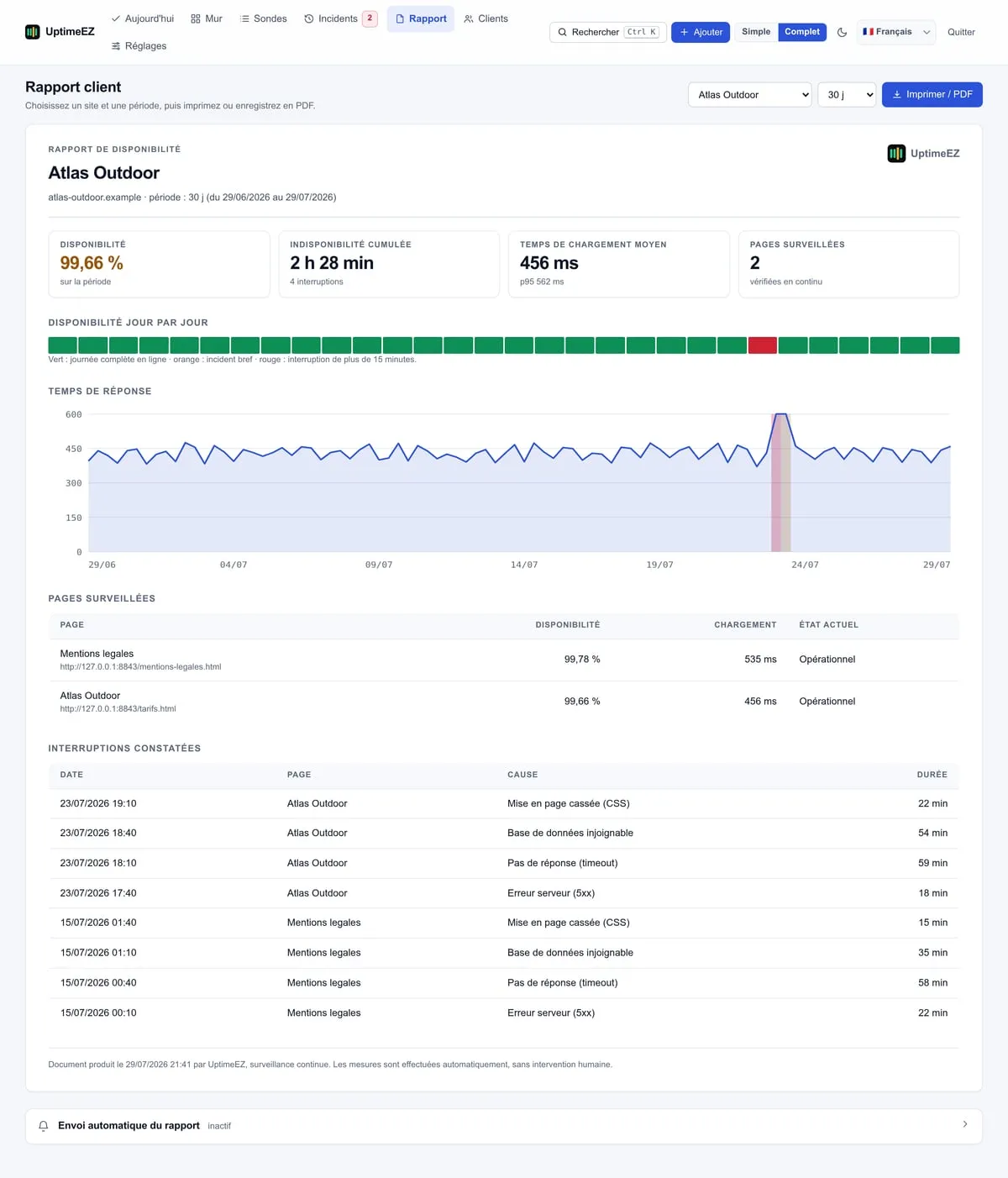
The critical indicators set at handover stay watched: backups, queues, certificates, scheduled jobs. When something leaves the green, we see it before your users do. Once a quarter, thirty minutes to review what ran, what was fixed and what might deserve to change. You decide what happens next, nothing is imposed.
An alert that lands in an inbox nobody opens is not monitoring. A person reads what the tool reports.
- More than an uptime pingThe tool also checks that the layout holds and that the database answers behind the page.
- A fix when it breaksAn incident on the delivered scope: we stabilize first, then write down what happened.
- Security updatesDependencies, patches and certificates, so your person does not have to follow every advisory.
Post-launch support, a maintenance contract or managed IT: what you actually buy.
Three things with similar names and very different incentives. The last row is the one to read first.
| Post-launch support compared with a ticket-based maintenance contract and managed IT services | Post-launch support | Maintenance contract | Managed IT services |
|---|---|---|---|
| Scope | Only what we built or assessed | Whatever tickets are raised on the application | Your whole estate: devices, email, network |
| What it is paid for | A watch on agreed indicators, light monthly fee | Tickets and hours consumed | Seats, devices and service levels |
| Where the knowledge sits | On your side since handover | Usually with the vendor | With the provider |
| Leaving | One month of notice, nothing degrades | Often a multi-year term | A transition project of its own |
| When it is the right choice | A delivered system you want watched for a year | An application nobody on your side can run | No IT team and many devices to look after |
Who watches your system: a tool, then a person.
A tool reads the indicators continuously, and a named engineer looks at what it reports. The people are the ones who delivered the system, so nobody has to rediscover it at two in the morning.
 Clairmont, technical leadArchitecture, backend, infrastructure and integrations: the foundation the watch covers.
 Laurent, founder and CTOThe quarterly review, and the decisions to take with you.
What you sign for post-launch support, in short.
- Price
- A light monthly fee, sized to the scope watched. It is set at handover, never from a grid.
- Term
- No minimum term. Cancel with one month of notice.
- Scope
- Exactly the delivered system. Not your devices, your workstations or your email: this is not managed IT.
- Dependency
- None recreated. Your trained person keeps the documentation and the controls. Nothing degrades if you leave.
- Obligation
- None. Every handover is complete with or without this arrangement.
Cost, scope, service levels: your questions first.
What are software support services?
Software support keeps an application in working order after it goes live: someone watches it, fixes what breaks, applies security updates and answers the people who use it.
Ours is deliberately narrow. It covers only a system we built or assessed, on the indicators agreed at handover, and it never becomes the only place where the knowledge lives.
Is this managed IT services?
No, and the distinction matters. We do not run your devices, your workstations or your email. The scope is exactly what we built or assessed during an engagement, and nothing else.
If you need someone to own your whole IT estate, a managed services provider is the right answer, and we will say so rather than stretch to fit.
Can we subscribe without a prior engagement?
No, and that is deliberate. This watches indicators that were set during a handover, on a system we know because we built or audited it.
For a system we have never seen, the honest first step is a short technical due diligence that maps what exists. After that, this becomes possible.
How much does it cost?
A light monthly fee, sized to the scope actually watched at handover. The figure is discussed at that point, when both sides know exactly what there is to watch. There is no minimum term: you can cancel with one month of notice.
Do you publish an SLA?
Yes, the one in our terms: support responses within forty-eight business hours, a critical defect addressed within twenty-four, both of which can be tightened in the contract. The alert thresholds for your own scope are written into the contract.
What happens if something breaks outside the scope?
We say so plainly and, where we can, point you to who should handle it. Stretching the scope silently would be the start of exactly the dependency this arrangement is designed to avoid.
If the incident shows that the boundary was drawn in the wrong place, that is a conversation to have openly, not a line quietly added to an invoice.
The engagement comes first. The watch comes after.
This arrangement is sized at the end of an engagement, on either side of what we do.
Build and automate
Software, automations and AI hosted in the EU, sources in your name.
Closer to your case
- Technical due diligence
We have not worked together yet: start by mapping what you actually run, at a fixed price.
Your engagement is ending? Decide what the next year looks like.
20 minutes to see what deserves a watch, and what can safely run on its own.
A 20-minute video call